The Complete Chandelier Size Guide: How to Choose the Perfect Fixture

The 3 Core Formulas of Chandelier Sizing
The foundation of good chandelier sizing rests on three simple, time-tested formulas. These calculations for diameter, height, and hanging height will be your trusted starting point for almost any space. Master these, and you’re already 90% of the way to a perfect fit.
How Do I Calculate the Right Chandelier Diameter (Width)?

The diameter, or width, of your chandelier is what determines its visual presence in the room. This first formula ensures the fixture is properly scaled to the horizontal dimensions of your space.
The Basic Room Dimension Formula
This is the most fundamental rule in lighting design. It’s simple, quick, and remarkably effective for finding a baseline size.
Room Length (in feet) + Room Width (in feet) = Ideal Chandelier Diameter (in inches)
For example, if you have a living room that is 14 feet long by 16 feet wide, you would add those two numbers together: 14 + 16 = 30. Therefore, a chandelier with a diameter of approximately 30 inches would be a great fit for that space.
The All-Important Exception: Sizing to a Table
If you are hanging a chandelier over a piece of furniture, like a dining table or kitchen island, that piece becomes your primary reference point, not the entire room. This is crucial for creating a visually connected and intimate setting.
- The Rule: Your chandelier’s diameter should be between one-half (1/2) and three-quarters (3/4) of the width of your table.
- The Clearance Rule: Ensure there is at least 6 inches of clearance on all sides, from the edge of the chandelier to the edge of the table. This prevents the fixture from feeling cramped and allows people to get up from the table without bumping into it.
How Do I Calculate the Right Chandelier Height?
Just as diameter relates to the room’s width and length, the chandelier’s own height (the vertical dimension of the fixture itself) should relate to the room’s ceiling height. This ensures the fixture has the right vertical proportion and doesn’t look too squat or too gangly.
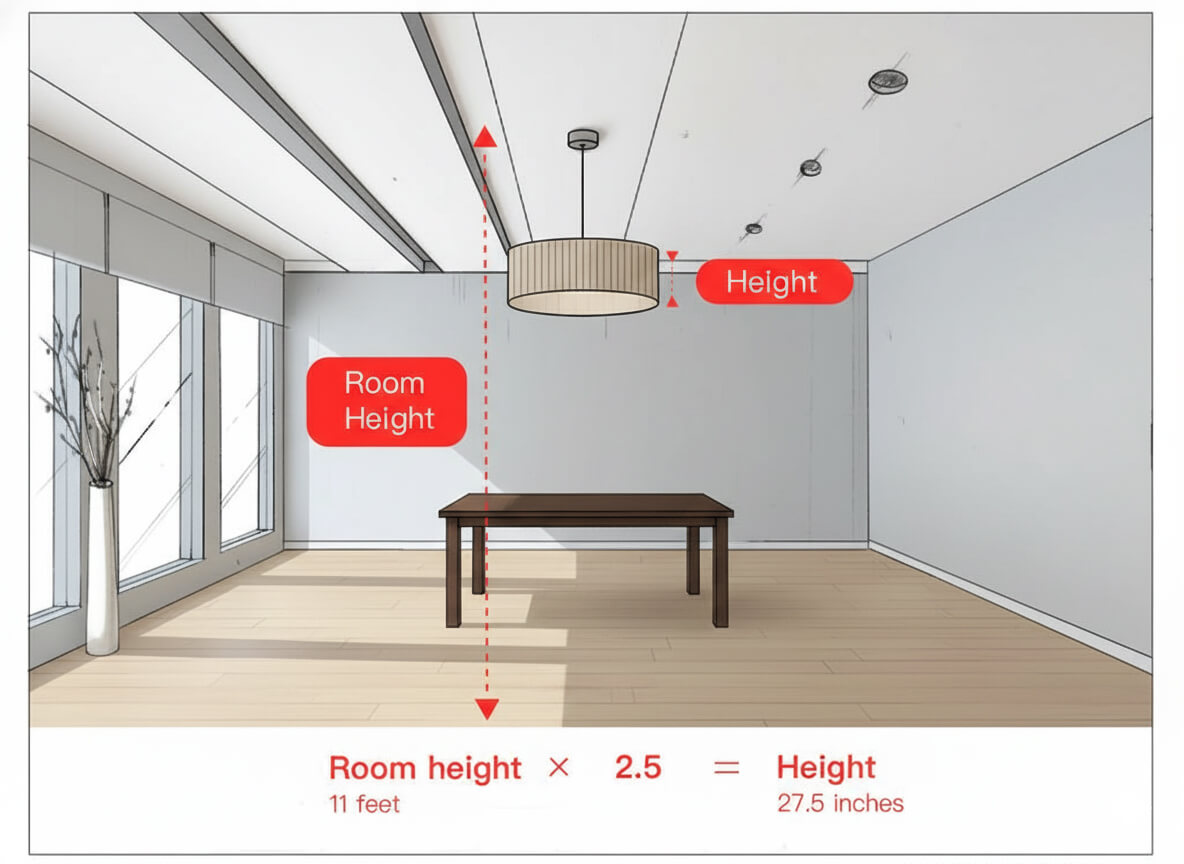
The Ceiling Height Formula
This simple calculation gives you a range for a well-proportioned fixture.
Allow 2.5 to 3 inches of chandelier height for every foot of ceiling height.
For a room with a standard 9-foot ceiling, your calculation would be: 9 x 2.5 = 22.5 inches and 9 x 3 = 27 inches. This means a chandelier with a body height between 22 and 27 inches will look perfectly scaled to the vertical space.
| Ceiling Height | Recommended Chandelier Height Range (in inches) |
|---|---|
| 8 ft | 20″ – 24″ |
| 9 ft | 22″ – 27″ |
| 10 ft | 25″ – 30″ |
| 12 ft | 30″ – 36″ |
| 14 ft | 35″ – 42″ |
| 20 ft | 50″ – 60″ |
How Do I Determine the Correct Hanging Height?
This is the final piece of the sizing puzzle. Hanging a chandelier at the correct height is critical for both function and aesthetics. The rules are different depending on where the fixture is placed.
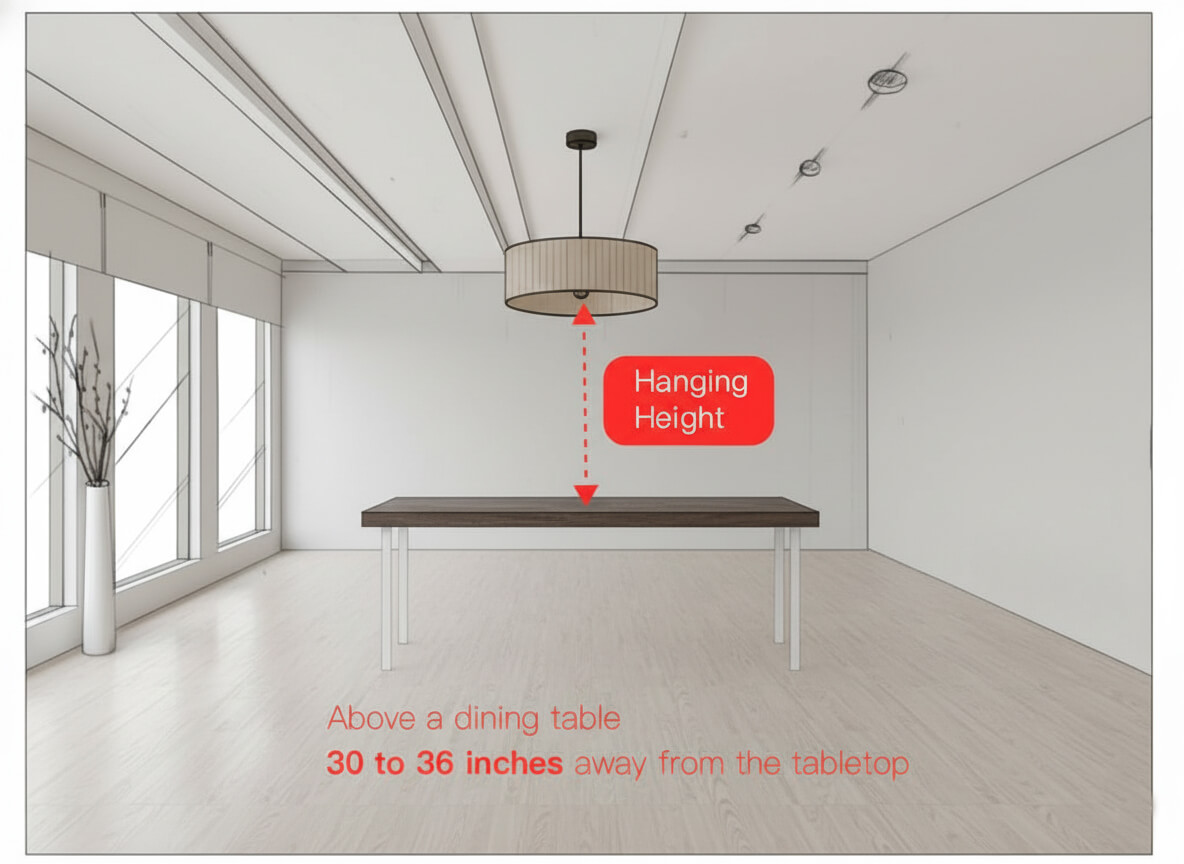
Scenario 1: Hanging Over a Table (Dining Room, Kitchen Island)
The goal here is to create a zone of light that illuminates the surface and feels connected to the furniture, without obstructing views.
The Golden Rule: The bottom of the chandelier should hang 30 to 36 inches above the tabletop.
Use the lower end of this range (30-32 inches) for standard 8-foot ceilings to keep the fixture from feeling too close to the ceiling. For taller ceilings (9 feet and above), you can move toward the higher end (34-36 inches) to give the fixture more breathing room.
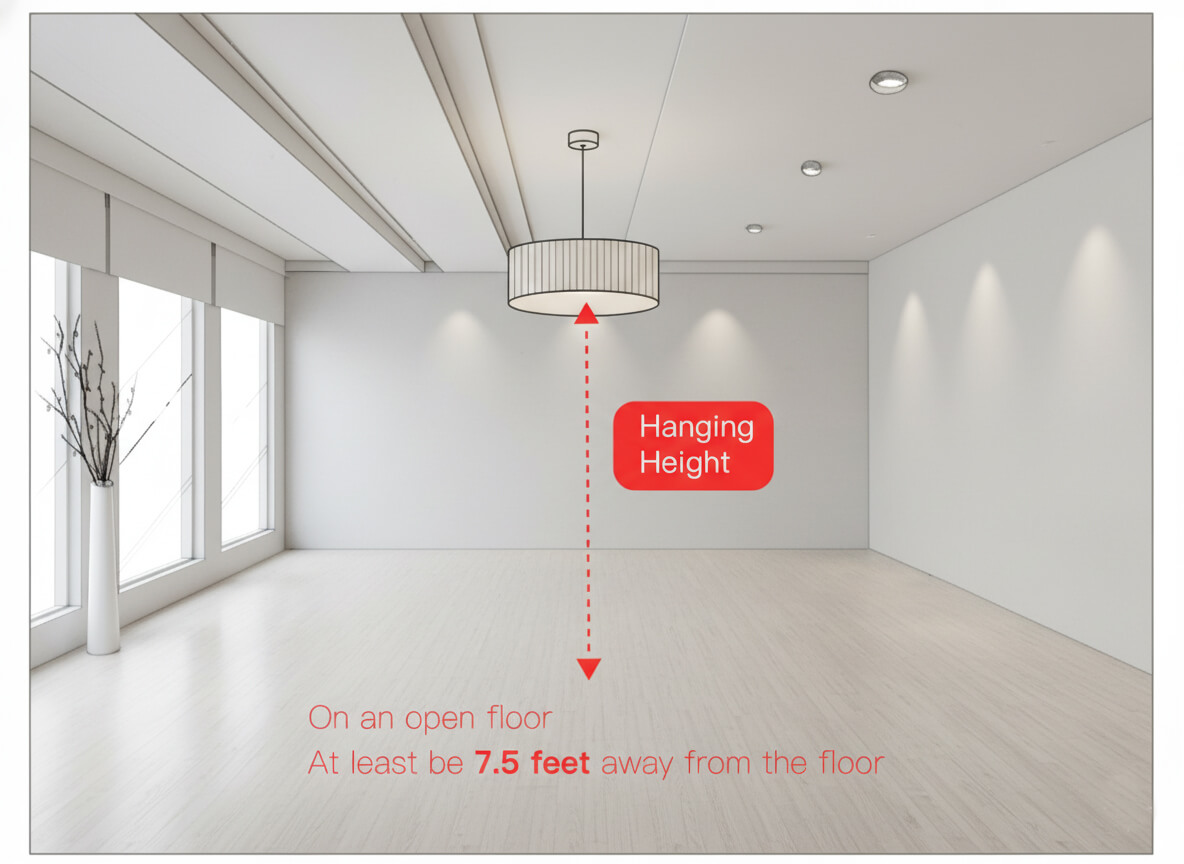
Scenario 2: Hanging in an Open Space (Foyer, Living Room, Bedroom)
In any area where people will be walking underneath the fixture, safety and clearance are the top priorities.
The Safety Rule: The bottom of the chandelier must hang at least 7 feet from the floor.
This ensures that even your tallest guests can walk comfortably underneath without the risk of bumping their heads. This is a standard rule from the Illuminating Engineering Society (IES) and is a best practice across the industry.
The Ultimate Room-by-Room Sizing Guide
Now that you have the core formulas, let’s apply them to the specific challenges and opportunities in each room of your home. Every space has its own unique considerations.
How Do I Size a Chandelier for My Dining Room?
In the dining room, the table is the star of the show, and the chandelier is its perfect accessory. The relationship between these two pieces is paramount.
- Anchor to the Table: Always remember that the table, not the room, is your primary guide. A chandelier with a diameter that is one-half to three-quarters the width of your table will create a beautiful sense of balance.
- Match Shapes: A round table looks wonderful with a round or square chandelier above it. A long, rectangular table is perfectly complemented by a linear chandelier or a series of two or three smaller pendants.
- Avoid Common Mistakes: The most common error is choosing a fixture that is too small, which can look insignificant. The second is hanging it too high, which disconnects the light from the table and makes the room feel less intimate.
How Do I Size a Chandelier for My Foyer or Entryway?
Your foyer chandelier is the first impression your home makes. It should be welcoming, stylish, and scaled appropriately to the architecture.
For a Standard, Single-Story Foyer (8-10 ft ceilings)
This is the most straightforward scenario. Use the basic Room Dimension Formula (Length + Width) to find your ideal diameter. The most important rule here is to strictly adhere to the 7-foot minimum floor clearance rule to ensure the entryway is safe and easy to navigate.
The Challenge of the Two-Story Foyer (12-20 ft ceilings)
A grand, two-story entryway requires a completely different approach. A standard-sized fixture will look like a toy.
- Go Bigger in Diameter: As a rule of thumb, you will likely need a chandelier that is 30-50% larger in diameter than what the basic room formula suggests.
- Prioritize Verticality: The fixture’s own height is more important than its width in these tall spaces. Look for multi-tiered designs or long, cascading styles that fill the vertical volume.
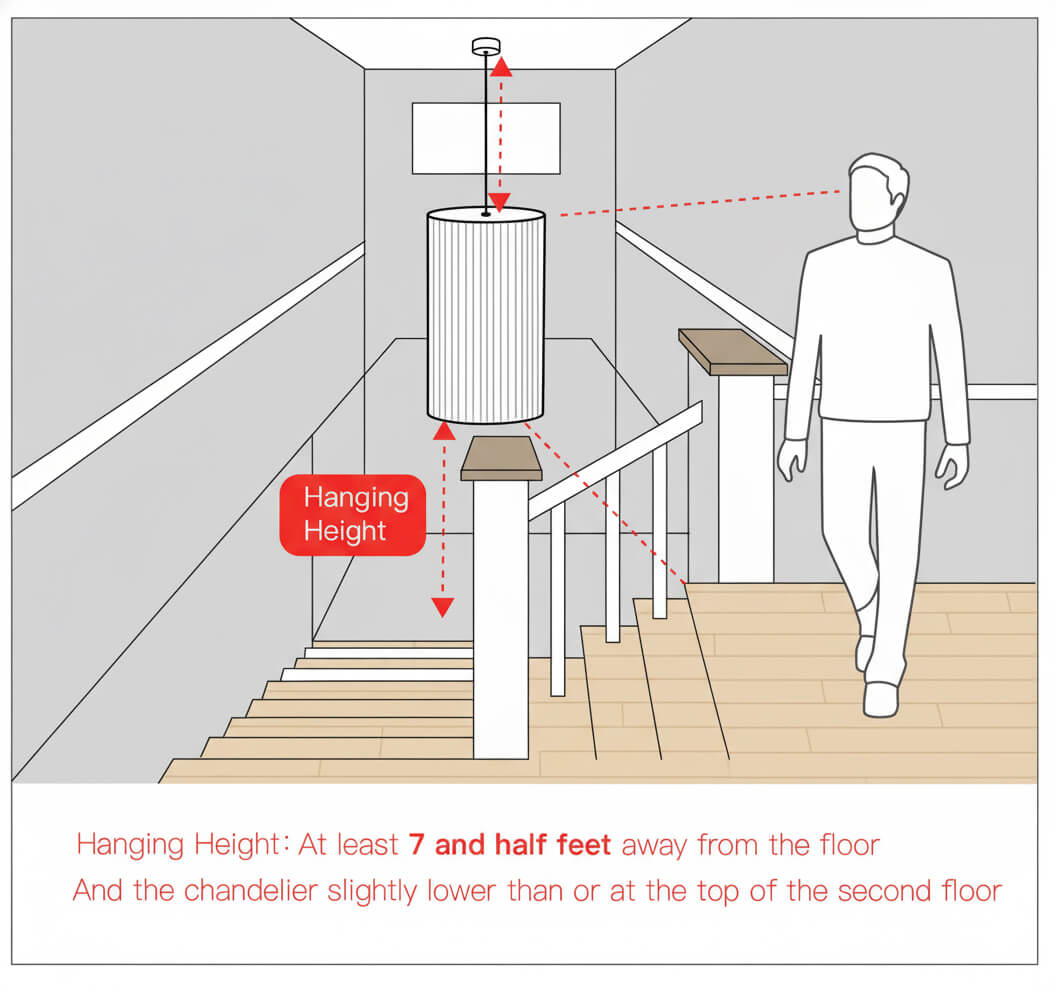
- Consider the Second-Floor View: The bottom of the chandelier should typically hang at or slightly above the level of the second floor. This ensures it looks great from both the ground floor and the upstairs landing.
- The Window Rule: If you have a large window above your front door, always center the chandelier within it. This creates a stunning visual from the outside and is a hallmark of high-end design.
How Do I Size a Chandelier for My Living Room?
The living room is a versatile space, and your chandelier placement should reflect how you use it. You have two main options for placement:
- Center of the Seating Area: If you have a well-defined seating arrangement, centering a chandelier over the coffee table can create a cozy and intimate focal point. In this case, use the coffee table’s width as your guide (chandelier should be 1/2 to 2/3 the width).
- Center of the Room: If your furniture is arranged more openly along the walls, centering the chandelier in the middle of the room provides the best overall ambient light. Use the room dimension formula for size and ensure at least 7 feet of clearance.
Also, consider the scale of your furniture. A room with big, comfy, overstuffed sofas can handle a more substantial and visually heavy chandelier. A room with sleek, minimalist furniture will look better with a fixture that is more light and airy in its design.
How Do I Size a Chandelier for My Kitchen?
In modern kitchens, the island has become the new dining table. It’s a workspace, a gathering spot, and the perfect stage for a statement light fixture.
- For a Single Fixture: If you’re hanging one chandelier or a large pendant over your island, treat the island like a dining table. The fixture’s width should be one-half to three-quarters the width of the island.
- For Multiple Pendants: This is a very popular and stylish look for longer islands. The key is spacing. A good rule is to space each pendant 24 to 30 inches apart from center to center. Also, leave about 12-15 inches from the edge of the island to the center of the first and last pendants to create a visually balanced line.
Can I Put a Chandelier in My Bathroom?
Yes, you can! A chandelier can add a touch of unexpected luxury to a master bathroom or powder room. However, safety is the absolute top priority. You must follow the strict electrical codes for wet environments.
The NEC Safety Code is NON-NEGOTIABLE: The National Electrical Code (NEC) states that any part of a hanging fixture must be at least 8 feet vertically OR 3 feet horizontally from the top edge of a bathtub rim or shower stall.
This means this is only a viable option for bathrooms with high ceilings. If your space complies, choose a smaller “mini-chandelier” and ensure it is officially “damp-rated” to withstand humidity.
Advanced Scenarios & Special Considerations
Sometimes, your space presents unique challenges that go beyond the basic rules. Here’s how to handle some of the most common advanced scenarios with confidence.
How Do I Correctly Size and Space Multiple Chandeliers?
Using multiple fixtures is a great way to illuminate a very large or long space.
- Over a Long Rectangular Table: A great approach is to use two chandeliers that are each about one-third the length of the table. To place them, divide your table into quarters. Center one chandelier over the first quarter-mark, and the other over the third quarter-mark. This leaves the ends and the center of the table feeling open and balanced.
- In a Long Hallway: Use the width of the hallway to determine the diameter of the fixtures (Width in feet x 2.5 = Diameter in inches). Space them approximately 8 to 10 feet apart down the center of the hall, ensuring all are hung at the same height with at least 7.5 feet of floor clearance.
How Do I Handle Sloped or Vaulted Ceilings?
This is a common feature in great rooms and modern homes. The key is ensuring your chandelier hangs straight down (plumb).
- The Easy Solution: Choose a chandelier that hangs from a chain or a cord. Gravity will naturally do the work, and the fixture will hang straight.
- For Stem-Hung Fixtures: If your chosen chandelier hangs from a rigid metal tube (a stem or downrod), you will need a special piece of hardware called a “sloped ceiling adapter” or “canopy swivel.” This adapter replaces the standard ceiling mount and has a pivot joint that allows the stem to hang plumb.
How Do I Size a Linear Chandelier?
Linear chandeliers are specifically designed for rectangular tables and kitchen islands. They have their own sizing rules:
| Dimension | Sizing Rule | The “Why” Behind the Rule |
|---|---|---|
| Length | Should be between 1/2 and 3/4 the length of the table. | This ensures the light is distributed evenly along the table without the fixture looking too short or too long. |
| Width | Should generally be no wider than 1/3 the width of the table. | Linear fixtures are meant to be sleek. Keeping the width narrow prevents it from feeling bulky and overwhelming. |
Beyond Size – Completing the Picture
The numbers will get you a fixture that fits. But these final considerations will help you choose a fixture that truly belongs.
How Does “Visual Weight” Affect Sizing?
This is a key design principle that experts use. A 30-inch, dense crystal chandelier with dozens of arms feels much “heavier” and visually larger than a 30-inch, minimalist single-ring chandelier. Think about the character of your room. A grand, traditional room with heavy wood furniture can handle a visually heavy fixture. A light, airy, modern room will look better with a fixture that is visually light. Don’t be afraid to choose a slightly larger diameter if the fixture’s design is very open and airy.
How Do I Calculate the Right Amount of Light (Lumens)?
A chandelier isn’t just decoration; it needs to provide useful light. In the age of LED, we measure this brightness in lumens. The Illuminating Engineering Society (IES) provides a simple formula to estimate the ambient light needed for a room:
Room Area (in sq. ft.) x Room’s Foot-Candle Recommendation = Total Lumens Needed
A “foot-candle” is a unit of light intensity. Different rooms have different needs.
| Room Type | Recommended Foot-Candles (for Ambient Light) | Example (12′ x 14′ Room = 168 sq. ft.) |
|---|---|---|
| Dining Room (Mood) | 10 – 20 | 1,680 – 3,360 Lumens |
| Kitchen (General) | 30 – 40 | 5,040 – 6,720 Lumens |
| Living Room / Foyer | 10 – 20 | 1,680 – 3,360 Lumens |
| Bedroom | 10 – 20 | 1,680 – 3,360 Lumens |
Check the “lumen output” on the chandelier’s specifications to ensure it provides enough light for your needs. Always install a dimmer switch to allow for mood adjustments.
Conclusion: From Formula to Fabulous – Sizing with Confidence
Choosing the right size chandelier doesn’t have to be a mystery. It’s a system. It’s a blend of simple, time-tested math and thoughtful design principles. By understanding how to calculate diameter, determine fixture height, and set the correct hanging height for any room, you have all the tools you need to make a great decision.
This knowledge is freedom. You are now free from the anxiety of guesswork. You can browse for chandeliers with a clear and confident vision of what will work perfectly in your space, allowing you to focus on the most enjoyable part: choosing a style that you absolutely love.
Frequently Asked Questions (FAQs)
Can a chandelier be too big for a room?
Yes, but it’s less common than choosing one that’s too small. A chandelier is “too big” if it violates practical clearances (hanging below 7 feet in a walkway or being wider than a table). Visually, a fixture with a very heavy, dense design can feel overwhelming even if its dimensions are technically correct. However, in rooms with high ceilings, homeowners often underestimate how large a fixture they need to make an impact.
How high should a chandelier hang in a 2-story foyer?
In a two-story foyer, the bottom of the chandelier should generally hang so that it is level with, or slightly above, the second-floor landing. This ensures it is a focal point from both the first and second floors. You must also ensure that the bottom of the fixture maintains at least 7 feet of clearance from the floor below.
What size chandelier should I use for a 10-foot ceiling?
For a 10-foot ceiling, you should look for a chandelier with a body height of approximately 25 to 30 inches (10 ft x 2.5″ = 25″, 10 ft x 3″ = 30″). When hanging it over a table, you can raise it to about 36 inches above the tabletop to better suit the taller ceiling.
How do you size two chandeliers over a long dining table?
For a long rectangular table, a great rule is to choose two chandeliers that are each about one-third the length of the table. To place them, imagine dividing your table into four equal sections. Center the first chandelier over the line between the first and second sections, and center the second chandelier over the line between the third and fourth sections. This creates perfect visual balance.
Is it okay to hang a chandelier over a bathtub?
Only if your bathroom meets strict safety codes. The National Electrical Code (NEC) requires that the bottom of the fixture must be at least 8 feet above the top of the bathtub rim. For most standard bathrooms, this is not possible. If your ceiling is high enough to meet this code, you must also use a chandelier that is rated for damp locations.
Should I center the chandelier in the room or over the table?
In a dining room, always center the chandelier over the dining table. The table is the functional centerpiece of the room, and the light should be anchored to it. This is true even if your dining table is not perfectly centered in the room. In other rooms like a living room or bedroom, you have the flexibility to do either, depending on your furniture layout.
From Formula to Fabulous: Sizing Your Chandelier with Confidence
Choosing the right size chandelier is not a mystery; it’s a system. It’s a perfect blend of simple, time-tested math and thoughtful design principles. By understanding how to calculate diameter, determine the right fixture height, and set the correct hanging height for any room in your home, you now have all the tools you need to make a perfect decision.
This knowledge is freedom. You are now free from the anxiety of guesswork and the fear of making a costly mistake. You can browse for your next great centerpiece with a clear, confident vision of what will not only fit but will truly elevate your space. Now you can focus on the most enjoyable part: choosing a style that you absolutely love.